
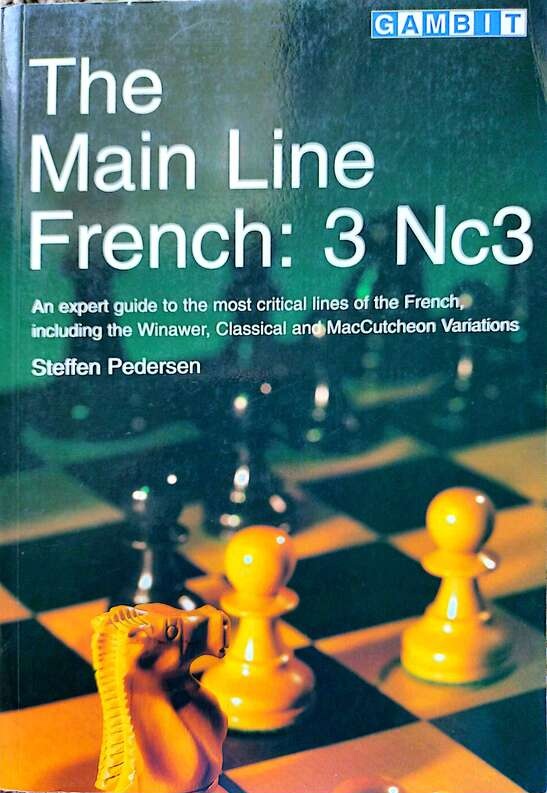
The Main Line French: 3.Nc3 by Steffen Pedersen
Starting bid: $12.00
Item condition: Used
Ending: June 28, 2026 12:00 am
Timezone: America/New_York
- Shipping : Less than one week
The Main Line French: 3.Nc3 by Steffen Pedersen
Written by International Master Steffen Pedersen, this comprehensive opening guide provides an in-depth examination of the Main Line French Defence arising after 1.e4 e6 2.d4 d5 3.Nc3. One of the most critical tests of the French Defence, this variation often leads to sharp tactical battles, complex strategic struggles, and rich middlegame positions where both sides have numerous opportunities for active play.
Pedersen combines detailed analysis with extensive verbal explanations, helping readers understand not only the theory but also the plans, pawn structures, and strategic ideas behind the variations. The book covers the major branches of the French after 3.Nc3, including the Winawer, Classical, Steinitz, MacCutcheon, Guimard, Rubinstein, and Burn Variations, making it a valuable resource for both French Defence players and those who face it regularly.
Topics Covered
- Main Line French Defence (3.Nc3)
- Winawer Variation and Poisoned Pawn lines
- Classical French systems
- Steinitz Variation ideas
- MacCutcheon Variation
- Guimard Variation
- Rubinstein Variation
- Burn Variation
- Typical pawn structures and strategic plans
- Transition from opening to middlegame
Key Features
- Comprehensive coverage of the French Defence after 3.Nc3
- Detailed analysis of major theoretical variations
- Strong emphasis on plans and strategic understanding
- Extensive verbal explanations alongside analysis
- Covers both tactical and positional approaches
- Includes numerous illustrative examples and variations
- Useful for both White and Black players
- Written by respected opening author Steffen Pedersen
Recommended For
Club players, tournament competitors, French Defence specialists, and serious opening students seeking a deeper understanding of the Main Line French, including its strategic concepts, tactical opportunities, and modern theoretical developments.
The Main Line French: 3.Nc3 by Steffen Pedersen
Written by International Master Steffen Pedersen, this comprehensive opening guide provides an in-depth examination of the Main Line French Defence arising after 1.e4 e6 2.d4 d5 3.Nc3. One of the most critical tests of the French Defence, this variation often leads to sharp tactical battles, complex strategic struggles, and rich middlegame positions where both sides have numerous opportunities for active play.
Pedersen combines detailed analysis with extensive verbal explanations, helping readers understand not only the theory but also the plans, pawn structures, and strategic ideas behind the variations. The book covers the major branches of the French after 3.Nc3, including the Winawer, Classical, Steinitz, MacCutcheon, Guimard, Rubinstein, and Burn Variations, making it a valuable resource for both French Defence players and those who face it regularly.
Topics Covered
- Main Line French Defence (3.Nc3)
- Winawer Variation and Poisoned Pawn lines
- Classical French systems
- Steinitz Variation ideas
- MacCutcheon Variation
- Guimard Variation
- Rubinstein Variation
- Burn Variation
- Typical pawn structures and strategic plans
- Transition from opening to middlegame
Key Features
- Comprehensive coverage of the French Defence after 3.Nc3
- Detailed analysis of major theoretical variations
- Strong emphasis on plans and strategic understanding
- Extensive verbal explanations alongside analysis
- Covers both tactical and positional approaches
- Includes numerous illustrative examples and variations
- Useful for both White and Black players
- Written by respected opening author Steffen Pedersen
Recommended For
Club players, tournament competitors, French Defence specialists, and serious opening students seeking a deeper understanding of the Main Line French, including its strategic concepts, tactical opportunities, and modern theoretical developments.
Similar Products